When I set out for the Enchantments last spring, I decided to swing hard toward ultralight and threw everything in a Zpacks Arc Haul Ultra 70L. The pack delivered on its promise — genuinely light, handles weight reasonably well — but by the end of the trip, my back was wrecked from chafing. The bungee back panel that creates airflow between the pack and your back is great in theory, but in practice the constant micro-movement rubbed me raw. For a trip that’s supposed to be one of the highlights of the Pacific Northwest hiking calendar, spending the last two days thinking about your back is not what you’re paying for.
So I started over.
What I Was Actually Looking For
My situation is pretty specific: I’d call myself a lightweight backpacker, not an ultralight one. There’s a difference. My dog Basil comes with me on longer trips, which means extra food, a bowl, and some extra gear. I like my camp chair. I’m not going to ditch my full sleep system for a down quilt that saves eight ounces. I care about weight, but I’m not willing to sacrifice comfort to chase a lighter number on a scale — and I think that’s a perfectly reasonable position. I just don’t want to be hauling a bomber traditional pack from REI that tips the scale at five pounds before I put anything in it.
The real target: something that handles 30–35 lbs comfortably, sits well on my hips, doesn’t beat me up over a long day, and is light enough that the pack itself isn’t eating into my weight budget. Sub-three pounds for the pack itself, ideally. And I wanted something that could handle a full five-day trip with confidence.
Why Durston
I already had some trust in Durston Gear from running the X Mid 2 Plus Pro tent. It’s a genuinely clever design and has held up well. What also stood out when I was researching the brand is that Dan Durston himself is consistently active in the Durston Gear subreddit — not just for PR purposes, but actually engaging with questions, technical issues, and feedback. For a small gear company, that kind of founder-level involvement tells you something about how seriously they take the product. Their warranty and customer service reputation is solid across the board.
The Kakwa 55 came up repeatedly in the “not ultralight, not bomber” conversation — the pack people point to when you say you want something between a Hyperlite and a Gregory. That was enough to pull the trigger.
The Pack at a Glance
The Kakwa 55 is Durston’s mid-weight workhorse — not a frameless ultralight pack, not a bombproof traditional pack. It comes in two fabric options: Ultra 200X (a UHMWPE-dominant hybrid) or UltraGrid (210D nylon with UHMWPE ripstop). The suspension system is a real one: a hollow aluminum inverted U-frame, a structured hip belt, and load lifter straps that actually do something.
| Spec | Value |
|---|---|
| Price | $279 |
| Weight (Ultra 200X) | 30.1 oz / 855g (S) · 31.5 oz / 895g (M) · 32.4 oz / 920g (L) |
| Weight (UltraGrid) | 29.2 oz / 830g (S) · 30.6 oz / 870g (M) · 31.3 oz / 890g (L) |
| Internal Volume | 53L (S) · 55L (M) · 57L (L) |
| External Pockets | 15L |
| Total Volume | 68L (S) · 70L (M) · 72L (L) |
| Frame | Hollow aluminum inverted U-frame (removable, 3 oz) |
| Max Rated Load | 45 lbs |
| Torso Sizes | S: 15–18" · M: 17–20" · L: 19–22" |
| Hip Belt | S/M: 29–38" · M/L: 33–42" |
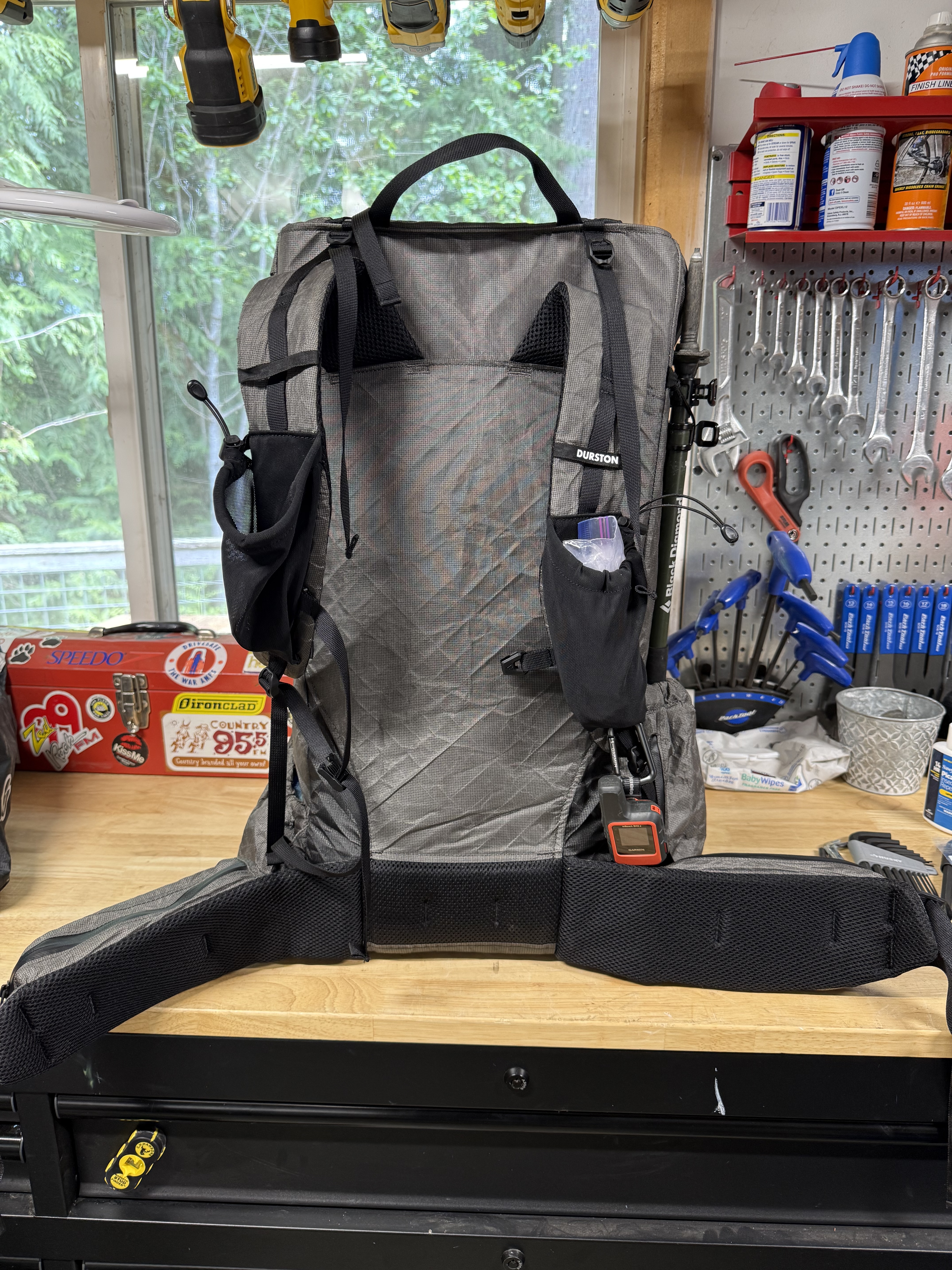
The back panel and hip belt laid flat — the structured aluminum frame and wrap-around hip belt are visible here.
Features Worth Talking About
Suspension & Load Transfer
This is where the Kakwa earns its keep. The load lifter straps work well — they’re the kind of feature you notice because the weight actually shifts off your shoulders when you cinch them. I’ve done 7–8 hour days with 30–35 lbs loaded and the pack has been comfortable end-to-end. The hip belt wraps well and transfers weight properly. Coming from the Zpacks, where the hip belt felt like more of a suggestion than an anchor, the difference here is meaningful.
The hip belt buckle system is also cleaner. The Zpacks Arc Haul uses dual adjustment straps on each side, which sounds like more control but in practice is just more stuff to fiddle with. The Kakwa’s single-strap buckle is simple, dials in fast, and stays put.
Side Pockets
Two side pockets, and they’re done right. The right side pocket is angled toward the front, which means you can reach your water bottle mid-stride without contorting your arm. That sounds like a small thing but over a full day of hiking it matters. I can carry two water bottles per pocket easily, which has been the setup I’ve been running.
Shoulder Strap Pockets
Two pockets on the shoulder straps — I’ve been using one for a small soft water flask for between water sources, and the other for snacks. Easy access on the move, no stopping to dig into the main compartment. The placement is good.
Hip Belt Pockets
Functional and well-sized. Fit my phone, a bar, lip balm, and some small stuff without issue. There are two nitpicks here:
First, the zipper has to make a 90-degree turn — it runs across the top of the pocket and then transitions down the side. At that corner, it consistently has difficulty fully closing. I’ve compared this to the Zpacks Arc H2O, which has a similar pocket design and zips fine, so it feels like a construction issue specific to this pocket. In practice it doesn’t matter much — there’s a small gap but nothing you’re carrying in there is going to escape — but it’s worth noting.
Second, because the hip belt wraps around your body properly (which is actually a good thing), the pockets themselves curve with it. If you’re trying to slide in a full-size bar, it resists the straight insertion. Not a dealbreaker at all, and I’d rather have a hip belt that wraps and actually transfers load than a flat one that’s easier to stuff — but some additional stretch material along the pocket opening might fix this entirely.
Main Compartment
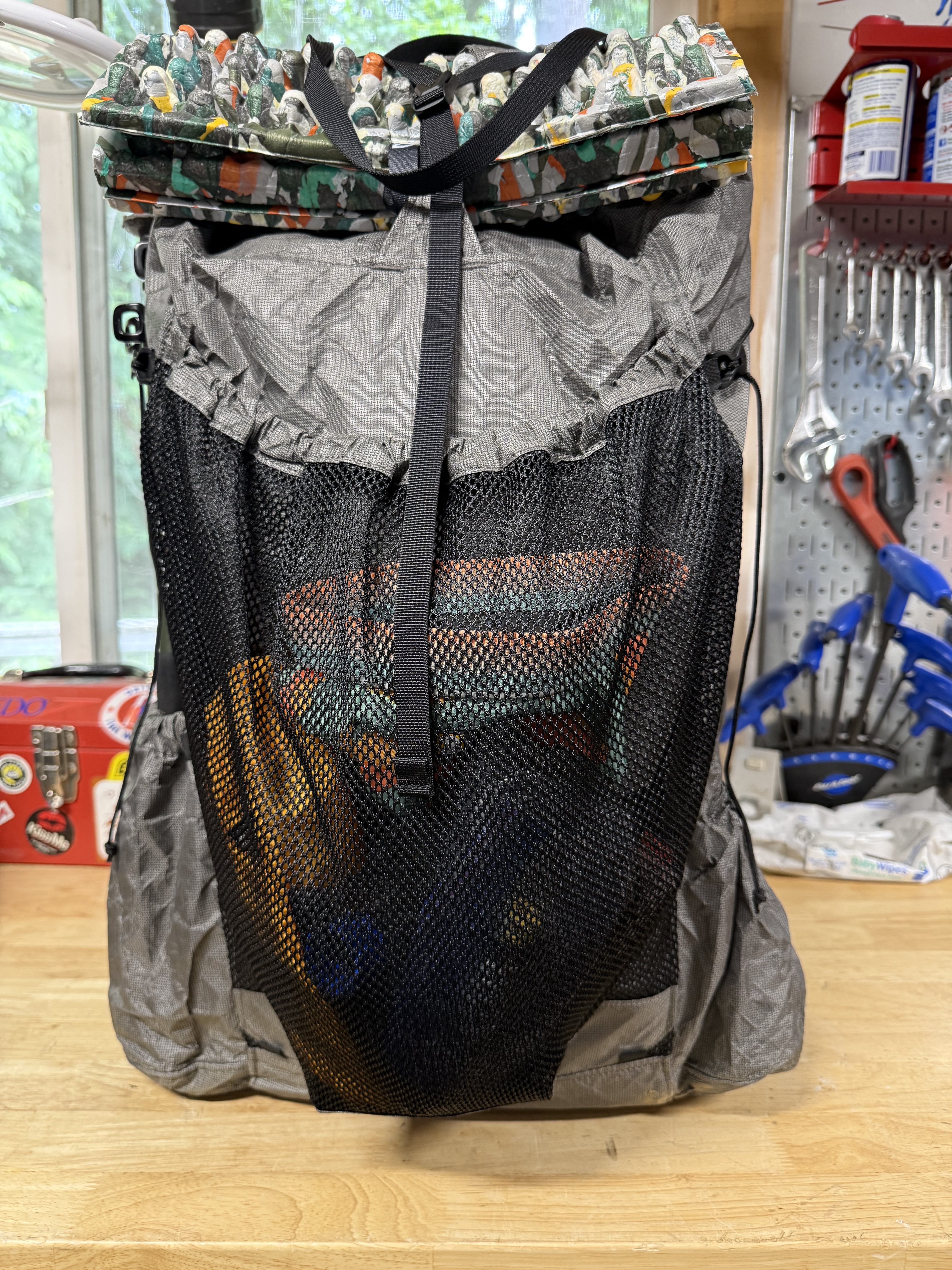
The large front mesh pocket loaded up — plenty of room for a quilt, wet layers, or anything you want accessible fast.
Roll-top closure, which is standard for packs in this category. Simple and effective — compact it down when you don’t need the full volume, open it up when you do. Loading and unloading is easy. No internal organization beyond what you build with stuff sacks, which is how it should be.
Back Pouch
Mesh pocket on the back for wet layers, snacks, or anything you want accessible without opening the main compartment. Works as advertised, seems durable.
Side Zipper Pocket
Small zipper pocket on one side panel — useful for keys, a car fob, small items you don’t want rattling around in the main compartment. I’ve been throwing my car keys in here and it’s been great.
Trekking Pole Holsters
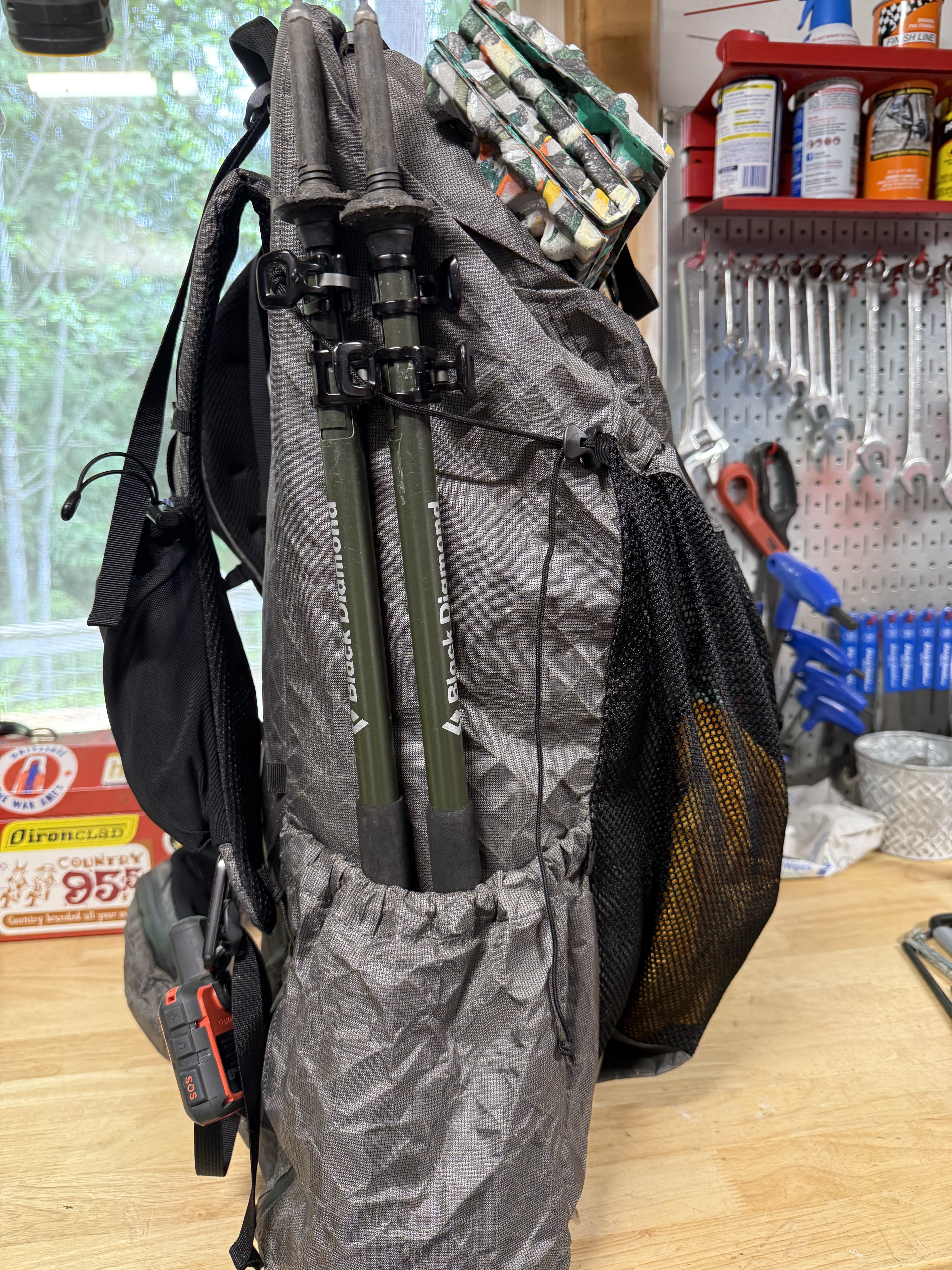
Side view with Black Diamond trekking poles secured — the angled side pocket and simple single-strap holster system are both visible.
Single elastic loop with a small side compression strap. Not going to secure a trekking pole on its own, but when you use both together it works reliably. The bigger compliment here is what it isn’t: the Zpacks criss-cross system required you to thread the pole through three separate loops, which made a simple task unnecessarily fiddly. The Kakwa’s approach is just a loop and a strap. Easy.
V-Strap
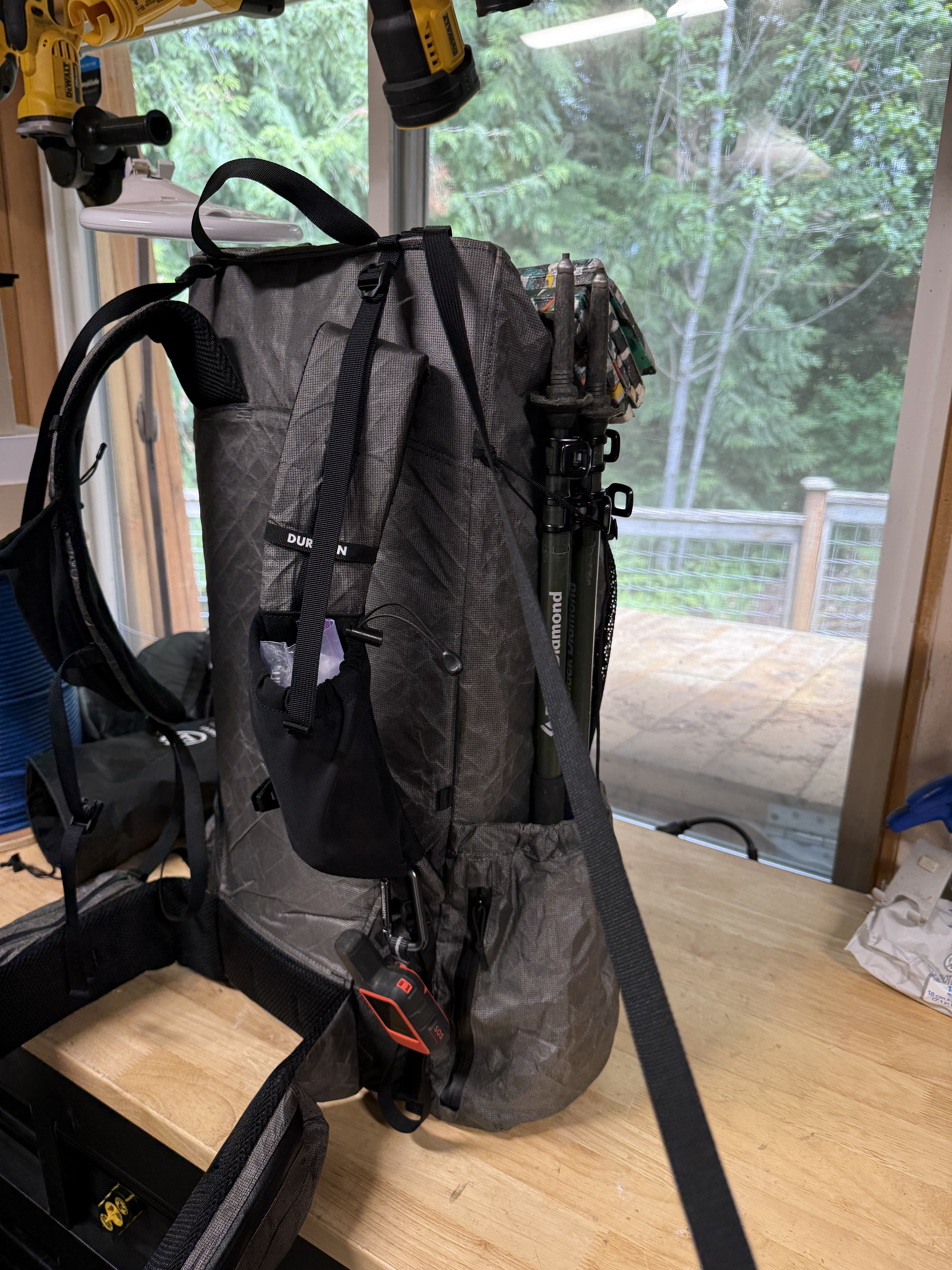
The other side, showing the Durston branding, hip belt pocket, and V-strap at the top.
A compression strap that runs over the top of the pack in a V-shape — useful for securing something flat on top (a wet tent fly, a bear canister, etc.) before you can get it inside. It’s adjustable on both sides of the V, which is nice.
One minor thing I’ve noticed: when the pack is full and the strap is routed but not in use, it sits against your body in a position that can be easily mistaken for a load lifter strap. It’s not confusing once you know the pack, but there’s a slight ergonomic clumsiness there. Minor.
The One Real Limitation: No Water Bladder Hanger
There’s an opening in the main compartment you can route a hydration tube through, but no hanging hook for the bladder itself. If you run a hydration system, you’ll need to rig something or just let the bladder sit in the main compartment unsecured. I don’t personally use a water bladder, so this is a non-issue for me, but it’s worth flagging for anyone who does.
Chafing: The Honest Answer
I did notice some hip chafing on longer days, concentrated where the hip belt edges contact skin. I want to be clear that this isn’t a Kakwa-specific problem — it’s the reality of any pack in this weight class. To get the load transfer you want from a proper suspension, you need the hip belt snug, and without thick foam padding, you’re going to get some contact. Body Glide fixes it. I’ve been using it proactively on anything over six hours and it’s been fine.
How It Compares to the Zpacks Arc Haul Ultra
I spent real time with both. Brief version:
The Arc Haul Ultra is lighter — meaningfully so. If base weight is the primary variable, the Zpacks wins. But the chafing from the bungee back panel was a real problem for me on the Enchantments, the hip belt doesn’t transfer load as well, and the hardware contact points on the shoulder straps were uncomfortable on longer days. The Arc Haul’s accessories (especially shoulder strap pouches) are excellent, and the water bottle side pocket is inexplicably harder to reach.
The Kakwa 55 costs you some weight versus the Zpacks but returns it in comfort, cleaner hip belt load transfer, and a back panel that actually stays put. For loads in the 30–35 lb range, I’ll take that trade.
Verdict
I’m genuinely happy with this pack. It fits the brief I set out with: comfortable enough to go all day at 30–35 lbs, light enough that I’m not carrying a pound of pack for every ten pounds of gear, and built with enough thought that the features actually work. I feel confident taking it on a five-day trip.
Is it perfect? No — the hip belt pocket zipper quirk is real, and the V-strap could be cleaner. But these are the kinds of nitpicks that come up when everything else is already working well. The big stuff — suspension, load transfer, side pocket ergonomics, trekking pole carry — is done right.
If you’re in the same position I was in — coming off an ultralight pack that was too aggressive, or a traditional pack that weighed too much, and looking for something that splits that difference intelligently — the Durston Kakwa 55 is worth a serious look.